Skip to content

Project · active

Heroes of the Host

Science-based browser action roguelite RPG that turns immune response into distinct class kits, infection scenarios, patient-state pressure, and persistent progression between runs.

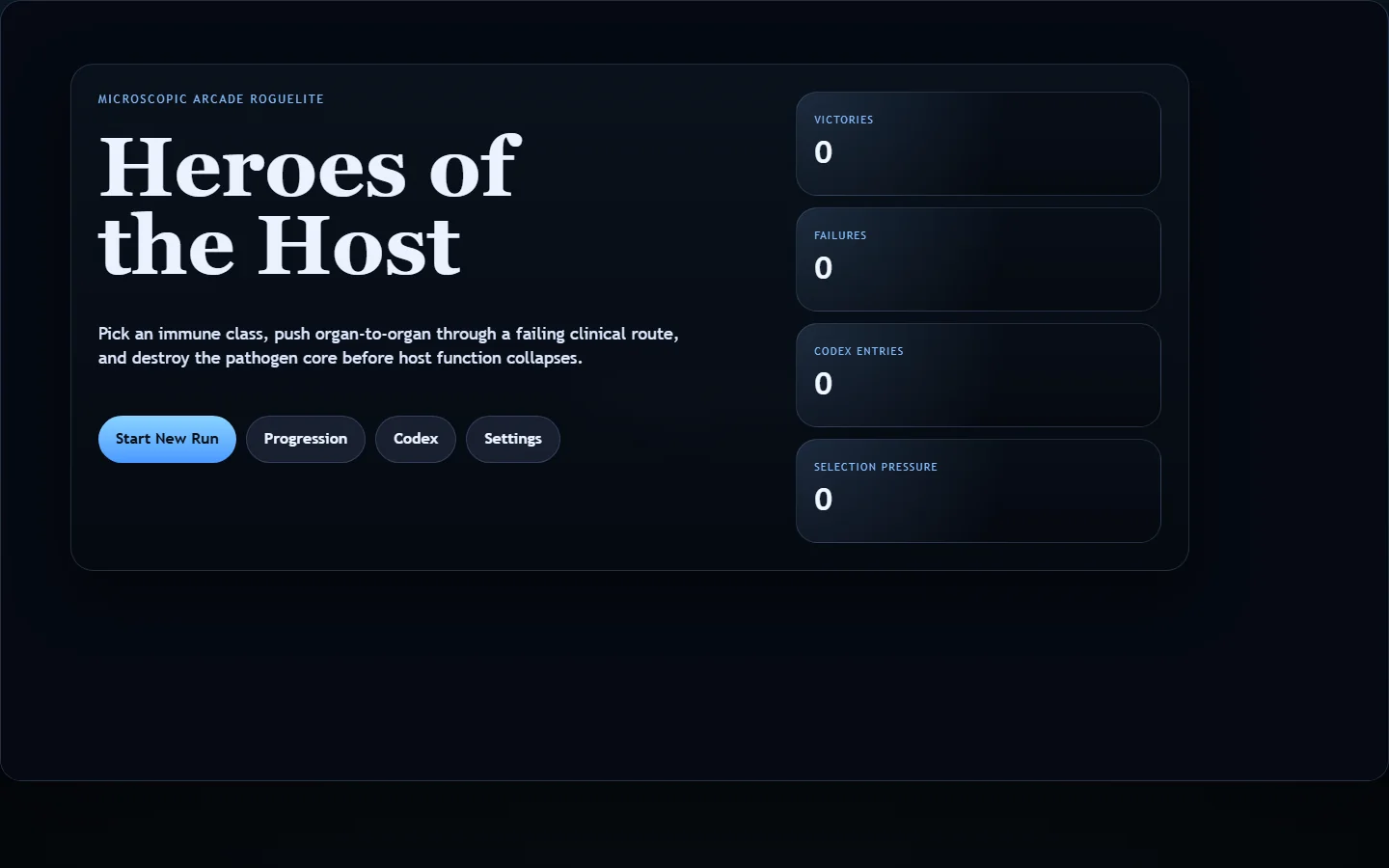
Heroes of the Host start screen with immune-cell game controls and run statistics

Purpose

Biology games often become either vocabulary exercises or thin arcade reskins. The design challenge was to make immunology drive the combat, progression, threats, and consequences while preserving the speed, readable decisions, and build variety expected from a modern action roguelite.

My role

Game designer, systems designer, scientific director, and engineer

Status

active

Methods

  • Phaser 3
  • TypeScript
  • Vite
  • Arcade Physics
  • Howler
  • localStorage
  • Roguelite systems design
  • Automated balance simulation
  • Playwright browser testing

Outputs

  • Playable standalone browser game and versioned website payload
  • Four immune-cell classes with distinct combat identities
  • Three infection routes with tissue objectives, pathogens, events, and bosses
  • Run-based ability drafts, item synergies, patient-state consequences, and persistent progression
  • Automated combat, lifecycle, collision, save, balance, and browser regression coverage

Result

The current alpha is a deployable, repeatable roguelite foundation with clinically inspired systems, readable enemy and item categories, persistent advancement, and a patient who can deteriorate or die when infection pressure is not controlled.

Implementation

How it works

Built with Phaser and TypeScript, each run begins with an immune-cell class such as a neutrophil, macrophage, natural killer cell, or B cell. The player moves through connected tissue rooms, protects the patient and local host structures, unlocks abilities during the run, assembles synergistic upgrades, and confronts route-specific pathogens and bosses across urinary, pulmonary, and meningeal infection scenarios. Persistent progression records discoveries and unlocks without removing the risk of patient death during a run.

The biology is intentionally simplified and occasionally embellished for play, but the underlying relationships are recognizable: cell types have roles based on real immune functions, pathogens create route-specific pressure, and collateral inflammation can damage the same tissue the player is trying to save. It is an entertainment game informed by immunology, not a clinical simulator or medical training product.